



Cybersecurity is no longer just an IT issue. It is a board-level concern that demands strategic leadership. Meeting the rigorous standards of CMMC Level 2 compliance and protecting sensitive Controlled Unclassified Information (CUI) requires an experienced hand guiding the ship. However, hiring a full-time Chief Security Officer (CSO) is often financially out of reach for small and medium-sized businesses.
Enter the Virtual Chief Security Officer (vCSO). This model provides organizations with top-tier security leadership at a fraction of the cost of a traditional executive hire. For defense contractors and SMBs alike, the vCSO represents a strategic advantage that levels the playing field against larger, better-funded competitors.
The cost of hiring a full-time CSO is prohibitive for many organizations. When factoring in base salary, benefits, bonuses, and recruiting costs, a full-time executive can easily exceed $300,000 per year . In contrast, vCSO engagements for mid-sized organizations typically range from $7,000 to $15,000 per month, representing savings of 30 to 70 percent compared to a full-time hire .
This cost efficiency does not come at the expense of quality. A vCSO brings decades of combined experience across multiple industries. Because they manage security programs for several clients, they see a wider array of threats and solutions than a single-company executive would ever encounter.
Many small and medium-sized businesses lack the internal expertise to manage compliance and security effectively. This leadership gap leaves organizations vulnerable to evolving cyber threats and ill-equipped to handle complex regulatory frameworks. A vCSO fills this gap by providing specialized knowledge and strategic direction.
The primary responsibilities of a vCSO include assessing cybersecurity risks, developing robust security policies, overseeing compliance initiatives, and creating long-term strategies that align with your business objectives. For defense contractors, this means having an expert who understands the intricacies of CMMC Level 2 and NIST SP 800-171 Rev. 2 .
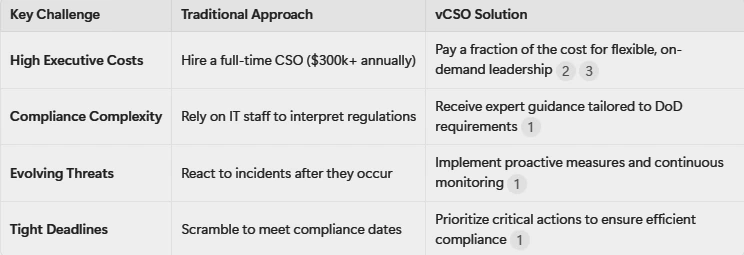
Cybersecurity threats are constantly changing. Ransomware, phishing, and supply chain attacks are becoming more sophisticated every day. A vCSO stays ahead of these emerging risks by continuously updating security protocols and implementing proactive measures .
Unlike an internal IT team that may be stretched thin managing day-to-day operations, a vCSO focuses exclusively on high-level strategy and risk mitigation. This ensures that your organization is not just compliant, but resilient. When a breach occurs, having a vCSO means you have a leader who knows exactly how to respond, minimize damage, and communicate effectively with stakeholders.
A common pitfall in cybersecurity is treating it as a purely technical issue. A vCSO ensures that security initiatives are tightly aligned with your overall business goals. Whether you are seeking to expand your government contracts, protect intellectual property, or build customer trust, a vCSO crafts a roadmap that supports these objectives.
For defense contractors specifically, this alignment is critical. The Department of Defense requires contractors to demonstrate not only technical compliance but also a mature security culture. A vCSO helps build this culture from the top down, ensuring that every employee understands their role in protecting sensitive data.
The vCSO model is more than just a cost-saving measure. It is a strategic investment in the future of your organization. By providing enterprise-grade security leadership without the enterprise-grade price tag, a vCSO empowers small and medium-sized businesses to compete confidently in the federal marketplace.
As compliance deadlines approach and cyber threats evolve, the question is no longer whether your organization needs executive-level security leadership, but how you will afford it. For many defense contractors, the answer lies in the flexibility, expertise, and affordability of a Virtual Chief Security Officer.