



Artificial intelligence is reshaping the defense industrial base from two directions at once. On one side, AI is a powerful accelerator of CMMC compliance, helping contractors gather evidence, close gaps, and prepare for audits faster than ever before. On the other side, careless AI adoption can undermine an organization's entire compliance posture. A single employee pasting Controlled Unclassified Information (CUI) into a public AI chatbot can violate multiple NIST SP 800-171 controls in seconds.
For defense contractors preparing for CMMC 2.0 Level 2 mandatory assessments, understanding both sides of this equation is critical. At V.I. Experts, we help organizations harness the power of AI while building the governance and controls that keep them compliant.
CMMC Level 2 compliance is a detail-heavy undertaking. Contractors must prove the implementation of 110 NIST SP 800-171 controls, document extensive evidence, and prepare for Certified Third-Party Assessment Organization (C3PAO) audits. This is precisely where AI tools can reduce the manual burden and accelerate readiness .
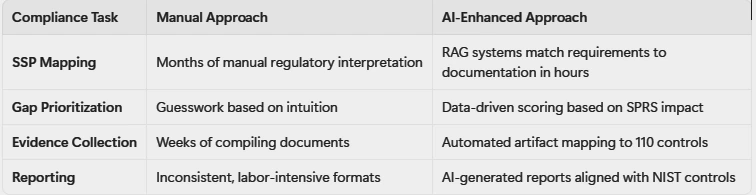
One of the biggest hurdles in CMMC readiness is aligning the System Security Plan (SSP) with NIST SP 800-171 controls. Contractors often spend months interpreting regulatory text and mapping it against their documentation. FedRAMP-authorized AI platforms, such as AWS Bedrock, can power retrieval-augmented generation (RAG) systems built on an organization's own compliance documentation. This makes it easier to spot gaps, connect requirements to SSP content, and prepare audit-ready documentation with fewer delays .
Once compliance gaps are identified, the next challenge is deciding which ones to fix first. Not every missing control carries the same weight. For example, failing to implement multifactor authentication can damage a Supplier Performance Risk System (SPRS) score more than a lower-value requirement. AI-driven automation platforms can flag vulnerabilities, assign remediation tasks, and track progress in real time, ensuring resources are directed where they are needed most .
Evidence collection is one of the most scrutinized parts of CMMC compliance. Assessors expect clear traceability between policies, implementation, and outcomes. AI-powered governance platforms can centralize compliance artifacts and map them directly to the relevant NIST 800-171 controls, keeping evidence secure, organized, and easy for assessors to verify .
The same technology that accelerates compliance can also jeopardize it. The central risk is data leakage. When employees use consumer AI tools to summarize documents, draft proposals, or analyze data, they may unknowingly feed CUI or Federal Contract Information (FCI) into systems that do not meet federal security standards .
This directly conflicts with core NIST 800-171 control families, including Access Control (AC), System and Services Acquisition (SA), and System and Information Integrity (SI). If sensitive data flows through an unvetted AI service, the organization can no longer demonstrate that its environment protects CUI confidentiality, putting CMMC certification at risk .
Beyond the technical controls, there is a legal dimension. Inaccurate self-assessments submitted to the Department of Defense can create False Claims Act exposure, a material risk that grows when organizations cannot verify where their data has been processed . As agentic and autonomous AI systems become more common in enterprise environments, the scope of what must be governed expands, making explicit AI usage policies a CMMC necessity rather than a nice-to-have .
Defense contractors do not have to choose between innovation and compliance. The key is adopting AI through a structured framework that aligns with CMMC requirements. At V.I. Experts, we recommend the following approach.
First, establish an AI usage policy. Define which tools employees may use, what data classifications are permitted, and what requires approval. This policy should be incorporated into your System Security Plan and communicated through regular training.
Second, use only vetted platforms. AI tools that will process CUI or FCI should carry the appropriate federal authorizations, such as FedRAMP or a FedRAMP equivalency. Public consumer chatbots should be explicitly blocked or restricted in environments handling sensitive data .
Third, implement technical safeguards. Deploy data loss prevention (DLP) tools, monitor AI-related network traffic, and enforce access controls on AI endpoints. These measures map directly to NIST 800-171 requirements and generate the evidence assessors look for.
Fourth, leverage AI for compliance itself. Once governance is in place, redirect the same AI capabilities toward accelerating your CMMC journey. Use FedRAMP-authorized platforms for SSP mapping, remediation prioritization, and evidence organization .
Navigating this balance alone is difficult for most organizations. Many defense contractors lack the internal expertise to both evaluate AI platforms and implement the associated controls. This is where experienced partners make the difference. V.I. Experts provides end-to-end guidance for defense contractors, from readiness assessments and gap analyses to Azure management for CMMC and 24/7 security monitoring. Whether you need a Virtual Chief Security Officer to establish governance strategy or certified professionals to prepare you for assessment, our team ensures that your AI adoption strengthens rather than threatens your compliance posture.
AI and CMMC 2.0 will only become more intertwined as the November 2026 Phase 2 deadline approaches. Organizations that build structured, governed AI programs will gain a dual advantage: faster compliance readiness and a stronger overall security posture. Those that adopt AI without governance risk costly violations that could end their federal contracting eligibility. The difference between these two futures is not the technology itself, but the expertise guiding its adoption.
Click Here or call (760) 388-2469 to Book a FREE Discovery Call.